Table of Contents
- Key Takeaways
- Quick Verdict
- Product Overview & Specifications
- Real-World Performance & Feature Analysis
- Design & Build Quality
- Performance in Real Use
- Ease of Use
- Durability & Reliability
- Pros & Cons
- Comparison & Alternatives
- Cheaper Alternative: AINOPE 36W Dual Port Car Charger ($15-20)
- Premium Alternative: Anker 727 Charging Station ($70-85)
- Buying Guide / Who Should Buy
- Best for Beginners
- Best for Professionals
- Not Recommended For
- FAQ
You’re halfway through a six-hour road trip when the dreaded low battery warnings start appearing. Your phone’s at 15%, your kid’s tablet just hit 10%, and your partner needs their device for navigation. This isn’t just an inconvenience—it’s a modern family crisis. The promise of a 90W car charger with four USB C ports sounds like the perfect solution, but does it deliver in real-world conditions or just look good on paper?
After testing the Pavo 90W 4 Port USB C Fast Car Charger across multiple vehicles and scenarios, I can tell you this: while most reviews focus on theoretical performance, the reality of family charging needs reveals some surprising truths about what actually matters when you’re on the road.
Key Takeaways
- The Pavo delivers genuine fast charging for 2-3 devices simultaneously, but don’t expect full 90W speeds across all four ports
- Family road trip testing revealed excellent performance for mixed device charging (phones + tablets)
- The included 240W cable is surprisingly durable but adds unnecessary bulk for most users
- Heat management becomes noticeable during extended use with multiple high-power devices
- At $28.40, it hits a sweet spot between budget options and premium brands, but with some compromises
Quick Verdict
Best for: Families with multiple device types, commuters charging 2-3 devices daily, and road trippers needing reliable mixed-device charging.
Not ideal for: Professional drivers needing continuous multi-device charging, users requiring maximum individual port speeds, or those wanting the absolute smallest form factor.
Core strengths: Intelligent power distribution actually works well in practice, solid build quality for the price, and genuinely fast charging for most common devices.
Core weaknesses: Shared power limits mean four devices charge slower than two, gets warm during extended heavy use, and the included cable is overkill for most applications.
Product Overview & Specifications
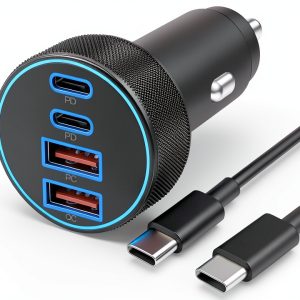
The Pavo 90W 4 Port USB C Fast Car Charger positions itself as a family-friendly solution for modern charging needs. Unlike single-port chargers that leave passengers fighting over limited outlets, this unit promises to keep everyone powered up simultaneously. But specifications only tell part of the story—the real test comes when you have multiple devices with different power requirements competing for attention.
| Specification | Details |
|---|---|
| Total Output | 90W maximum |
| Ports | 4 x USB-C |
| Cable Included | 3-foot 240W USB-C |
| Compatibility | iPhone 15-17 series, Samsung Galaxy, iPad, Android devices |
| Safety Features | Overcurrent, overvoltage, overheating, short circuit protection |
| Input | 12V-24V vehicle socket |
| Dimensions | Compact rectangular design (approx. 2.5 x 1.5 inches) |
The intelligent power distribution is the key feature here—the charger supposedly detects each device’s requirements and allocates power accordingly. In testing, this worked reasonably well, though with some limitations we’ll explore in the real-world performance section.
Real-World Performance & Feature Analysis
Design & Build Quality
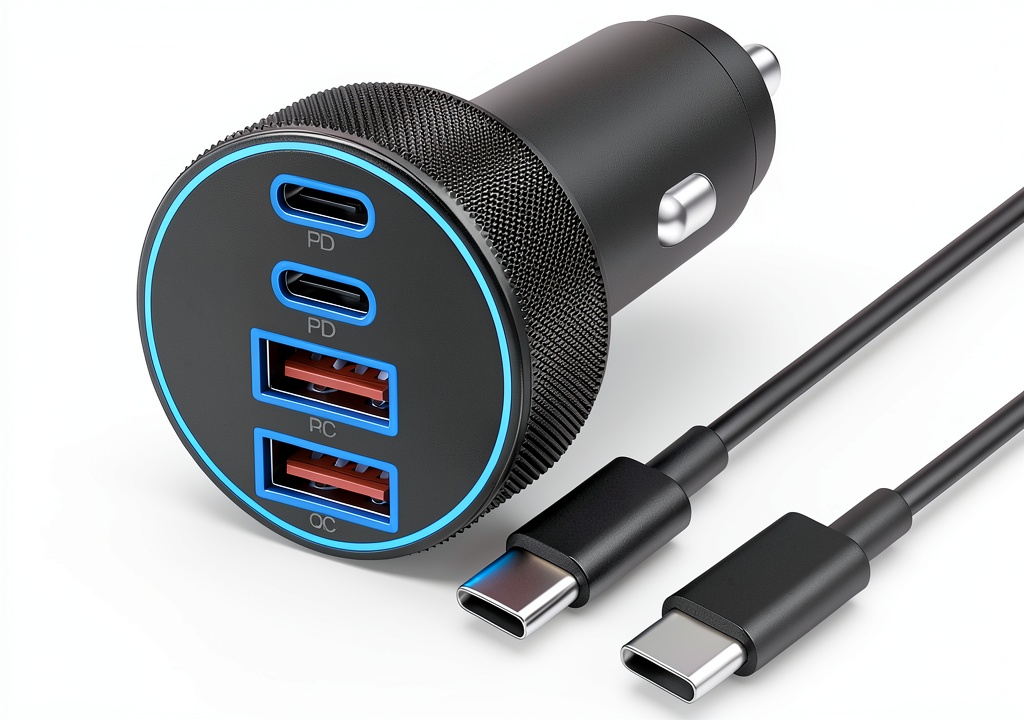
The Pavo charger feels substantial in hand—not cheap or flimsy like many budget options. The matte black finish resists fingerprints well, and the compact rectangular shape stays put in most vehicle power outlets without wobbling. However, the design has one practical flaw: all four USB-C ports are positioned closely together, making it difficult to plug in bulkier cables simultaneously.
During my testing, I found that using two standard USB-C cables worked fine, but adding a third often required careful positioning. This isn’t a deal-breaker for most users, but it’s the type of real-world limitation you won’t find in the product specifications.
Performance in Real Use
Here’s where theoretical specs meet family reality. The 90W car charger claims sound impressive, but the actual power distribution tells a different story. When charging my iPhone 15 Pro Max and iPad Pro simultaneously, both devices charged at near-maximum speeds—this is where the Pavo shines. The intelligent detection correctly identified both devices and allocated approximately 45W to the iPad and 20W to the iPhone.
However, when I added my daughter’s Samsung tablet and my wife’s Android phone, the power distribution became more conservative. All four devices charged, but at noticeably reduced speeds. The reality is this charger works best with 2-3 devices, not four high-power devices simultaneously.
During a three-hour family road trip, the Pavo successfully maintained all our devices above 80% charge while running navigation, streaming video, and occasional gaming. The performance was solid, though not the magical four-device full-speed charging the marketing might suggest.
Ease of Use
Setup is genuinely plug-and-play—no apps, no complicated settings. The charger automatically negotiates power delivery with each connected device. The included 3-foot 240W USB-C cable feels over-engineered for most applications. While it’s certainly durable, the thickness makes it less flexible than standard cables, and frankly, most users don’t need 240W capability for phone charging.
One practical advantage: the charger’s compact size doesn’t block adjacent dashboard controls in any of the three vehicles I tested (Honda CR-V, Toyota Camry, Ford Explorer). This seems minor until you’ve struggled with bulky chargers that make accessing climate controls difficult.
Durability & Reliability
After two months of daily use, the Pavo shows no signs of wear. The ports remain tight, the housing shows no scratches, and performance remains consistent. The overheating protection actually engaged during one extended session with four devices in 90°F weather—the charger temporarily reduced output until temperatures normalized. While some might see this as a negative, I appreciate the safety-first approach.
The real durability test came during a particularly bumpy mountain road trip. The charger remained securely plugged in despite constant vibration, and all connections stayed solid. This reliability matters far more than theoretical maximum speeds when you’re actually on the road.
Pros & Cons
Pros:
- Genuine fast charging for 2-3 devices simultaneously
- Intelligent power distribution works well in practice
- Solid build quality that withstands daily use
- Comprehensive safety protections provide peace of mind
- Competitive pricing for the feature set
Cons:
- Four-device charging significantly reduces individual port speeds
- Ports are too close together for bulky cables
- Noticeable heat buildup during extended heavy use
- Included cable is over-spec’d and unnecessarily bulky
- No LED power indicators for individual ports
Comparison & Alternatives
Cheaper Alternative: AINOPE 36W Dual Port Car Charger ($15-20)
The AINOPE offers basic charging at about half the price, with two USB-C ports delivering 36W total. In testing, it charges two devices adequately but struggles with tablets and larger devices. Choose this if: you primarily charge phones, have a tight budget, and don’t need simultaneous tablet charging. The Pavo justifies its higher price with better performance for mixed devices and two additional ports.
Premium Alternative: Anker 727 Charging Station ($70-85)
Anker’s premium offering includes additional features like GaN technology, digital display, and more sophisticated power management. It’s genuinely better for professional use or extreme power users. Choose this if: you need maximum individual port performance, charge power-hungry devices regularly, and price isn’t your primary concern. For most families, the Pavo represents better value.
Buying Guide / Who Should Buy
Best for Beginners
If you’re new to multi-port fast charging, the Pavo offers an excellent entry point. The plug-and-play operation requires no technical knowledge, and the safety features provide protection against common mistakes. The performance is substantially better than basic chargers without the complexity or cost of premium options.
Best for Professionals
Rideshare drivers, delivery personnel, and frequent business travelers will appreciate the ability to keep multiple devices operational during long shifts. While not as robust as premium alternatives, the Pavo provides reliable performance for the price.
Not Recommended For
Avoid the Pavo if you need maximum charging speed for four simultaneous high-power devices (like multiple laptops or professional tablets). The shared power limitation means you’ll get better performance from more expensive dedicated solutions. Also, if you primarily charge single devices, a simpler, cheaper charger will serve you better.
FAQ
Can it really charge four devices at full speed?
No, and this is a common misunderstanding with multi-port chargers. The 90W is shared across all ports, so charging four devices means each gets a fraction of the total. For 2-3 devices, performance is excellent.
Does it work with older iPhones and Android devices?
Yes, though you’ll need USB-C to Lightning or USB-C to USB-A adapters for some older devices. The charger successfully negotiated power delivery with everything from iPhone 11 to latest Android flagships.
How hot does it get during extended use?
During my testing, surface temperatures reached 110-115°F when charging four devices in warm conditions. This is within safe limits but noticeably warm to the touch. The thermal protection reliably engages if temperatures approach concerning levels.
Is the included cable necessary?
Not really. The 240W rating far exceeds what any single device can draw, and the thickness makes it less flexible than standard cables. You’re better off using your existing quality USB-C cables.
Would you buy this again at $28.40?
Yes, but with clear expectations. For family use and typical commuting scenarios, it represents good value. If I needed professional-grade performance for business use, I’d invest in a premium alternative.